Thursday, May 18, 2017

A Congressman Said Making A Man Get Maternity Insurance Was Crazy A Women Reply Went Viral

Between rounds of jeering that interrupted his every sentence, Rep. Rod Blum (R-Iowa) took a little more than two minutes to explain what else he'd like to change about the Obama-era health-care law now that he has voted for the GOP's partial repeal of the Affordable Care Act.
“Get rid of some of these crazy regulations that Obamacare puts in,” Blum suggested at an Iowa town hall meeting Monday, “such as a 62-year-old male having to have pregnancy insurance.” The crowd yelled all the louder.
The gathering in a Dubuque high school gym went on for more than an hour like that: angry questions, political explanations, boos from the bleachers.
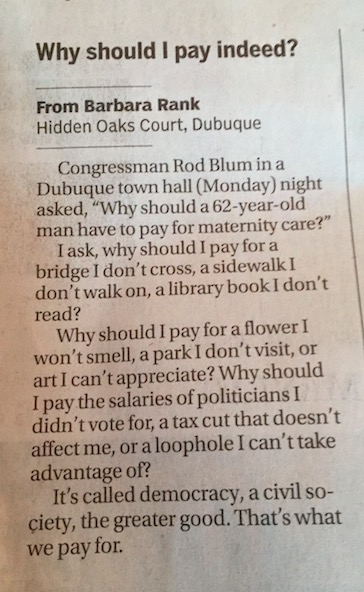
Barbara Rank, a retired special education teacher, did not get up from her seat like many of her neighbors did. “I did not have a question to ask,” she told The Washington Post. But the next day, on her morning walk past a boulevard of government-maintained flowers, Rank realized she had a response to Blum. She wrote it down in 96 words and sent it to her local newspaper — and since then, more than 100,000 people have offered a fair critique.
From the May 12 Telegraph Herald. (Courtesy of Barbara Rank via The Washington Post) 
Rank, 63, has an AOL email account but no Facebook account. She learned what Reddit was only on Friday, she said, when her daughter informed her that someone had posted a snapshot of her letter under the headline, “This is democracy manifest,” and that tens of thousands of people were voting it onto the website's front page.
“It makes me laugh,” Rank said. “It's such a silly little piece.”
Tell that to the Daily Kos, where a writer thanks her “for calling out ignorant so-called public servants like Rod Blum of Iowa.”
Or to thousands of like-minded commenters on Reddit and Twitter.

Around Of Premium Hikes Brewing: Blame Trump or Obama?

WASHINGTON (AP) — Another year of big premium increases and dwindling choice is looking like a distinct possibility for many consumers who buy their own health insurance — but why, and who's to blame?
President Donald Trump has seized on early market rumbles as validation of his claim that "Obamacare" is a disaster, collapsing of its own weight. Democrats, meanwhile, accuse Trump of "sabotage" on a program he's dissed and wants to dismantle.
It's more complicated, say some independent experts. Trump inherited some problems and risks making things worse.
Many insurers in the subsidized markets created by the Affordable Care Act are still struggling to overcome financial losses. The cost of care for their new customers turned out higher than expected, a fundamental factor driving premiums higher and nudging some insurers to the exits next year.
But the Trump administration has also sent mixed signals that insurers find unsettling.
On the positive side, a market stabilization regulation gave the industry changes it wanted. And Wednesday, officials announced an enrollment option intended to make it easier for insurers and brokers to sign customers up.
However, insurers' top priority has become a political football. Trump keeps hinting he might stop paying billions of dollars in subsidies to reduce deductibles and copayments.
Insurers are also worried that under Trump the IRS will ease up enforcing the health law's unpopular requirement that most individuals have coverage, seen as driving healthy people into the market. Finally the GOP legislation in Congress would cut private insurance and Medicaid subsidies indirectly flowing to the companies.
The impact will vary by state and insurer, but "I think it is the case that the uncertainty we are dealing with is adding to the premium increases this year," said Cori Uccello of the American Academy of Actuaries, which represents experts who make long-range cost estimates for health care and pension programs.
Oregon is the latest state to unveil insurers' premium requests for 2018: 7 out of 8 carriers are seeking double-digit increases. Nationally, about 20 million people buy their own health insurance policies. Roughly half receive subsidies through the ACA marketplaces, and are cushioned, but the rest will face the brunt of increases. In the latter group are many early retirees, self-employed professionals and small business owners — a traditional Republican constituency.
In Virginia, seven insurers are seeking average premium increases that range from just under 10 percent to more than 50 percent. Kurt Giesa, a partner with the Oliver Wyman consultancy, said such a wide spread signals to him that some insurers may be pricing for political uncertainty.
"Insurers are operating under a lot of uncertainty right now, and really, the uncertainty isn't being cleared up," he said. "The administration isn't clearing up the uncertainty." Virginia state officials declined to comment.
Standard & Poor's analyst Deep Banerjee had earlier forecast relatively modest increases. Now he's not so sure. "There is a cloud of uncertainty that is hanging over 2018," he said.
In Maryland, where five insurers are seeking increases that average from 18 percent to nearly 59 percent, Insurance Commissioner Al Redmer, Jr., says he's told the companies he's not inclined to make allowances for political uncertainty.
"Trump hasn't been in office for three or four years, and for anybody to try to point to him as the problem, that's either falsifying history or delusional," said Redmer, a Republican. The fundamental factors are sicker customers and higher operating costs, he added. "Congress needs to put aside partisan differences and fix the ACA."
Pennsylvania Insurance Commissioner Teresa Miller said she's not expecting price shock in her state, but she's convinced the Trump administration isn't helping. "They would rather destabilize the markets and see them fail," said Miller, appointed by a Democratic governor.
If that is Trump's strategy, it could well fail. In a recent poll by the nonpartisan Kaiser Family Foundation, 75 percent said his administration should do what it can to make the health care law work. Three out of five said Trump and the Republican Congress are responsible for any future problems.
In Tennessee, the CEO of a major insurer says political uncertainty has the potential to raise premiums.
"Given the potential negative effects of federal legislative and/or regulatory changes, we believe it will be necessary to price-in those downside risks," JD Hickey of BlueCross BlueShield of Tennessee wrote to Insurance Commissioner Julie Mix McPeak earlier this month.
Translation: Part of the company's premium request may reflect the impact of uncertainty.
In a statement, the Trump administration said the problems lie with the ACA, not its own stewardship. "It requires impressive mental gymnastics to make the case that Obamacare is working," said spokeswoman Alleigh Marre.
But former President Barack Obama's Medicare administrator said Trump is deliberately trying to make things worse.
"This is purposeful so that the president can create a crisis and use that to force the Congress to pass his law," said Andy Slavitt. "He's holding the match."
Progress Reducing Uninsured Rate Comes To A Halt

WASHINGTON (AP) — Five years of progress reducing the number of Americans without health insurance has come to a halt, according to a government report out Tuesday. More than a factoid, it shows the stakes in the Republican drive to roll back the Affordable Care Act.
The report from the Centers for Disease Control and Prevention estimates that 28.6 million people were uninsured in 2016, unchanged from 2015. It was the first year since passage of the health care overhaul in 2010 that the number of uninsured did not budge.
The uninsured rate for 2016 was 9 percent, an insignificant difference from 9.1 percent the previous year. When former President Barack Obama signed the ACA in 2010, the uninsured rate had been 16 percent.
Tuesday's report suggests that the ACA was running low on gas in Obama's final year as president. Premiums for private insurance were about to jump, and 19 states continued to refuse the law's Medicaid expansion.
Now, the number of uninsured could start climbing again under policies being considered by President Donald Trump and congressional Republicans.
The politically unpopular GOP bill passed narrowly by the House would limit Medicaid financing and curtail subsidies for many consumers buying their own private policies. Republicans also would repeal the requirement that most Americans carry health insurance or risk fines, a much-disliked nudge to get healthy people covered.
The legislation would lead to an estimated increase of 24 million uninsured people within 10 years, according to congressional analysts. Under "Obamacare," there are 20 million fewer uninsured since 2010.
"It's disappointing that it's stalled out," said health economist Gail Wilensky, a Republican. "The real question is, will we be able to keep the gains that we have made?" Critical of the ACA and co-author of an alternative plan by GOP policy experts, Wilensky nonetheless supports the goal of expanding coverage. She's concerned about the impact of the House bill on Medicaid, the federal-state program for low-income and disabled people.
The new numbers come from CDC's National Health Interview Survey, which is considered an authoritative source, and publishes findings earlier than the Census Bureau. Estimates for 2016 were based on data for nearly 97,500 people.
"It looks like we are kind of sticking a landing and holding on to the gains," said Katherine Hempstead, who directs research on health insurance at the nonpartisan Robert Wood Johnson Foundation. "To increase coverage, you would have to see more states take up the Medicaid expansion, and some reforms to increase take-up in the individual (private) market."
Could the number of uninsured start rising again? Absolutely, say both Wilensky and Hempstead.
"This release is really timely because it just helps everybody focus on what's at stake," said Hempstead.
The report found a significant increase in the percentage of people under age 65 covered last year through government-sponsored insurance markets like HealthCare.gov. About 11.6 million (4.3 percent) had marketplace insurance in the last three months of 2016, compared with 9.1 million (3.4 percent) in the same period the previous year.
States that expanded Medicaid were more effective at reducing the number of uninsured. Of the 16 states with adult uninsured rates significantly lower than the nation as a whole, 15 expanded Medicaid. In that group, only Wisconsin had not extended coverage for low-income people.
Conversely, of the nine states that had significantly higher uninsured rates, only New Mexico expanded Medicaid.
The CDC numbers do not reflect any changes directly attributable to Trump, who took office this year on Jan. 20.
During the campaign and since, the president has made some big promises about health insurance, talking of coverage for everybody and much more affordable premiums and deductibles. But Trump has also embraced a GOP bill that would make more people uninsured, even if it delivers on his campaign pledge to repeal "Obamacare." And he's threatened to stop paying subsidies that reduce out-of-pocket costs such as deductibles for people with modest incomes.
Hillary Clinton, whom Trump defeated, had promised to increase government assistance for private insurance costs, and also work to convince holdout states to expand their Medicaid programs.
"This is really pre-election activity" reflected in the CDC survey, said Wilensky. "It's news because people need to know we seem to have reached a plateau." What that will look like a year from now is unclear, she added.

Sunday, May 7, 2017

Senate Likely To Slow Repeal Of Obamacare, May Write New Bill

Passage of the House's health-care bill gives the Obamacare repeal effort new life after months of wrangling, but key Republican senators are already pushing it aside to write their own bill with no clear timetable to act.
The narrowly passed House measure can't get anywhere near the 51 votes needed as is, even though Republican senators insist they're united on delivering on their seven-year vow to repeal and replace the Affordable Care Act. Instead, they want to write their own bill.
Lamar Alexander of Tennessee, who chairs the Senate health committee, Rob Portman of Ohio, and Roy Blunt of Missouri, a member of GOP leadership, described the plan even as the House was celebrating passing its repeal after weeks of back-and-forth.
"We'll write our own bill," Alexander said in an interview, although he said senators would consider pieces of the House bill. "Where they've solved problems we agree with, that makes it a lot easier for us."
The decision will delay the prospect of any repeal bill reaching President Donald Trump's desk. Before the failure of the House bill in March, Senate Majority Leader Mitch McConnell had talked of taking it up and passing it in a week.
A senior White House official said the administration is ready for a slower, more deliberative debate in the Senate, where the main sticking point is expected to be how to address Obamacare's expansion of Medicaid.

AHIP Issues Statement as the American Health Care Act Heads To The Senate

WASHINGTON, D.C. – Marilyn Tavenner, president and CEO of America’s Health Insurance Plans (AHIP), offered the following statements upon the passage of the American Health Care Act (AHCA) by the House of Representatives:
“AHIP believes that every American deserves coverage and care that is affordable and accessible, including those with pre-existing conditions. The American Health Care Act needs important improvements to better protect low- and moderate-income families who rely on Medicaid or buy their own coverage. We stand ready to work with members of the Senate and all policymakers, offering our recommendations for how this bill can be improved to ensure the private market delivers affordable coverage for all Americans.
“Immediate challenges exist in the individual market today, and the bill includes key provisions to stabilize the market in 2018 and 2019. We need certainty now about funding for cost-sharing reductions that lower copayments for patients so they can better afford to get care from their doctor. The tax credit should be enhanced to reduce premiums and better meet the needs of people with low and modest incomes, are older, or live in areas with high health care costs.
“We want to work with the Senate to ensure the continued strength of the Medicaid program, which delivers real value to more than 70 million Americans.  States need adequate resources to administer an efficient, effective program that helps beneficiaries improve their health. If changes are made to criteria for who is covered by Medicaid, we need to give people more time to adjust – and more time for the individual market to stabilize.
“More than 80 million Americans rely on the Medicaid and individual market, and they deserve affordable coverage and access to quality care. AHIP believes that by working together, we can create good private market solutions that improve the health and financial stability of all people.”
About AHIP
America’s Health Insurance Plans (AHIP) is the national association whose members provide coverage for health care and related services to millions of Americans every day. Through these offerings, we improve and protect the health and financial security of consumers, families, businesses, communities and the nation. We are committed to market-based solutions and public-private partnerships that improve affordability, value, access and well-being for consumers. Visit www.ahip.org  Learn more about health insurance and how it works at myhealthplan.guide

New 8 Billion For Those With Preexisting Conditions Appears to Boost AHCA Critics Say Amount Is To Low

On May 3, 2017, the House of Representatives may have broken the gridlock that has prevented its passage of Republican changes to the Affordable Care Act. Representative Fred Upton (R MI) and six other moderate Republicans offered what they viewed as a corrective amendment (summary) to the MacArthur-Meadows amendment to the American Health Care Act (AHCA). MacArthur-Meadows, offered to secure the votes of conservative Republican members of the House Freedom Caucus, authorized states to obtain waivers to permit their insurers to charge higher rates based on health status to individuals with preexisting conditions for a period of about a year if those individuals let their insurance coverage lapse for a period of at least 63 days.
The House appears set to vote on the AHCA on May 4, without waiting for a new score from the Congressional Budget Office.
The Upton amendment would create a fund of $8 billion for the years 2018 to 2023. The money would go to states that permit insurers to charge higher health-underwritten premiums to such individuals; the funds would be used to provide “assistance to reduce premiums or other out-of-pocket costs of individuals who are subject to an increase in the monthly premium rate for health insurance coverage as a result of such waiver.” The funds would be apportioned to the states taking into account other stabilization fund grants.
The amendment has been described as funding state high-risk pools. A state could certainly use its share of the $8 billion to fund risk pools as one approach to making coverage affordable to persons subject to high premiums because of their health status. But the money could also be used to directly subsidize the premiums or cost-sharing that high-cost consumers might have to pay for commercial insurance.
Others have commented that $8 billion falls well short of the amount needed to adequately ensure coverage to high-risk consumers and have additionally noted the problems that have plagued high-risk pools in the past. There is also the question of a strategy that allows insurers to up-rate people who do not maintain continuous coverage, purportedly to discourage breaks in coverage, but then seeks to cover the cost of the penalty when the consumer seeks insurance again after the coverage break.
In any event, the Upton amendment is likely to be added to the AHCA as it currently exists on May 4 and may bring in enough votes to secure passage in the House of the bill. The fate of the AHCA in the Senate, however, is a whole another matter, as the Senate operates on different procedural rules that may well block a number of parts of the AHCA and with a much smaller, and quite diverse, Republican majority.

Trump, GOP Lawmakers Planning Obamacare Repeal


Vice President-elect Mike Pence visited with House GOP lawmakers on Wednesday morning to discuss President-elect Donald Trump’s first moves in the Oval Office, including a plan to repeal ObamaCare by Feb. 20.
The date was put forth by incoming House Budget Committee Chairman Diane Black (R-Tenn.). Pence announced during a press conference Wednesday morning that the Trump Administration’s first order of business will be to follow through on the important campaign promise of repealing and replacing the Affordable Care Act, also known as ObamaCare.
Through both executive action and legislation, Trump and GOP lawmakers aim to dismantle the healthcare law and replace it with a free-market based system. Pence offered scant details of what a replacement system would look like, however he ensured that any GOP sponsored fix would be less problematic for Americans than ObamaCare itself.
Pence noted that he and Trump are in “the promise-keeping business” on repealing the law, jabbing at President Barack Obama for the many empty promises surrounding his crowning achievement. Obama and Democratic lawmakers often shared the falsehood that Americans could keep their current doctors, healthcare plans and providers once ObamaCare went into effect, which turned out to be untrue.
Pence added that the American people spoke in November when they elected Trump, who made healthcare a focal point of his campaign. Pence said the election results show Americans want a “better future for healthcare in this country,” and alluded to a Department of Health and Human Services report that shows health care premiums for those enrolled in ObamaCare are expected to increase on average by 25 percent in the coming year.